
Since 1 November 2026, social media providers must verify the identity of every advertiser before an ad is published. The rule, widely called 'No ID, No Ads', comes from an Electronic Transactions Commission notification published on 5 May 2026, and it sits on top of the risk-based advertiser verification Meta already asks of notified advertisers whose ads reach Thailand. This guide covers what the rule requires, how it interacts with Meta's own checks, and what it does and does not change for teams running Thai campaigns on agency ad accounts. It is a practical summary, not legal advice.
What the 'No ID, No Ads' rule is
The rule is the Electronic Transactions Commission's Notification on Measures for Prevention of Technology Crime for Online Social Media (No. 2). It was published in the Government Gazette on 5 May 2026 and took effect on 1 November 2026.
It places the verification duty on social media providers rather than directly on advertisers, but the practical effect lands on anyone whose ads reach Thai users: the platform has to know who you are before your ad can run.
Our news report on the rule's launch covers the announcement itself.
What platforms must do
Under the notification, social media providers must:
- Verify the identity of every advertiser before an ad is published, using documents or a digital identity system
- Keep details such as name, identification number and contact information for at least 90 days after the advertising relationship ends
- Apply the same rules where a third-party payer, such as an ad agency, is involved
- Treat a verification as valid for up to a year
How it sits alongside Meta's own verification in Thailand
Meta was already asking. Its October 2025 developer post expanded verification for advertisers whose ads reach audiences in Thailand, global campaigns included, and who meet its risk criteria. Notified advertisers had up to seven days to verify, then had to name the beneficiary and payer shown in the ad's Ad info section and the Ad Library, set as a default in Ads Manager's advertising settings or per ad set through the API. Missing the deadline meant ads could not be delivered to users in Thailand.
Thailand's own rule is broader: Meta's expansion was risk-based and applied to notified advertisers, while the national rule requires platforms to verify every advertiser before an ad is published. Both ask the same underlying question, who benefits from and who pays for ads reaching Thai users, so answer it once, clearly, for every account you run.
Financial services ads: a separate verification track
Meta lists Thailand among the regions where ads for financial products and services require verification (check Meta's current list). Before running them, you verify the advertiser and the payer, or only the advertiser if it also pays, and then choose which verified advertiser and payer appear in Ad info and the Ad Library.
Brand ads for banks and insurers, financial news and financial education are among the ads Meta treats as out of scope.
What an agency ad account changes, and what it does not
An agency ad account is a normal Meta ad account that sits in a provider's business portfolio and appears in yours as a partner asset. Your buyers build and publish campaigns from your Business Manager; the payment method, billing details and receipts stay with the provider. That changes who Meta bills, and Meta's charges, currency and any Thai VAT follow the provider's account.
It does not change anything tied to the ads themselves. Verification for ads reaching Thailand, Meta's ad review and policies, and Thai law that applies to whatever the ad promotes all follow the ads, whoever owns the account. The 'No ID, No Ads' rule also explicitly covers third-party payers such as agencies, so an agency set-up is not a way around it.
In Meta's definitions for agencies and resellers, the advertiser is the client whose ads are published, and in a reseller set-up the payer is the reseller that owns the business portfolio the ad set runs from. Meta recommends that clients verify themselves, which needs at least partial access to the ad account plus access to the portfolio it sits in.
What to do before launching Thai campaigns
Settle the verification roles before a notice arrives, not after delivery stops.
- Write down who the advertiser and payer are for each account
- Confirm the client has the access Meta needs to verify: at least partial access to the ad account plus access to the portfolio it sits in
- Disclose only entities that genuinely fit Meta's definitions of advertiser and payer
- Never borrow someone else's verified identity; it is not a fix and breaks Meta's rules
- For financial products and services, verify the advertiser and payer before the ads go live
Related Thai rules to check
Verification is only the first gate. A few other Thai rules follow your ads onto Meta whoever owns the account; our full Thailand guide covers each in detail, along with VAT, currency and spending limits.
- Health products: food benefit claims (including dietary supplements), drugs and medical devices need Thai FDA advertising approval, and prescription-only medicines can't be advertised to the public
- Alcohol: Meta lists Thailand among the countries where alcohol ads can't run, and Thai law restricts alcohol advertising
- Gambling: Meta doesn't allow online gambling or social casino ads in Thailand, and Thai law penalises helping to advertise unauthorised gambling
- Crypto: ads need Meta's written permission backed by an SEC Digital Asset Business licence
How Power Ads fits
Power Ads supplies Meta agency ad accounts only and does not manage campaigns. Accounts are shared into your Business Manager through partner access and paid on our corporate cards, with unlimited accounts, free replacements and 24/7 support on Telegram and WhatsApp.
Pricing is 4% per top-up, with no setup, monthly or per-account fee, and the service is built for teams spending roughly $100k+ a month on Meta. Verification under Meta's rules and the 'No ID, No Ads' notification, licences and compliance stay with your team.
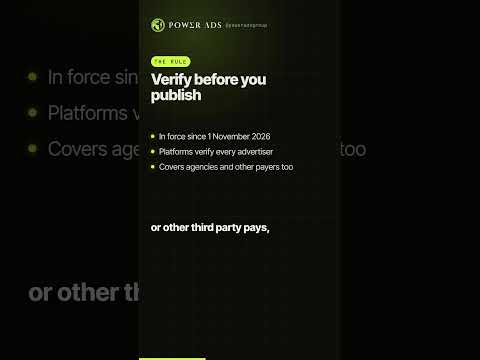 Watch the 60-second versionThailand's 'No ID, No Ads' rule: what Meta advertisers must do now · YouTube Short
Key takeaways
- Thailand's 'No ID, No Ads' rule, an ETC notification published on 5 May 2026, has applied since 1 November 2026.
- Platforms must verify every advertiser's identity before an ad is published and keep details for at least 90 days after the advertising relationship ends; a verification lasts up to a year.
- The rule also covers third-party payers such as ad agencies, and it sits on top of Meta's own risk-based verification for ads reaching Thailand.
- On an agency ad account, billing follows the provider, but verification, Meta's ad review and Thai law follow the ads.
- Record the advertiser and payer for each account and make sure the client can verify before Thai campaigns launch.
FAQ
What is Thailand's 'No ID, No Ads' rule?
It is an Electronic Transactions Commission notification, published on 5 May 2026 and in force since 1 November 2026, requiring social media platforms to verify every advertiser's identity before ads are published. Platforms keep advertiser details for at least 90 days after the advertising relationship ends, the rules also cover third-party payers such as agencies, and a verification lasts up to a year.
Does an agency ad account avoid advertiser verification in Thailand?
No. The account sits in the provider's business portfolio and the provider handles billing, but verification, Meta's ad review and Thai law follow the ads. The national rule explicitly covers third-party payers such as agencies, and Meta recommends that clients verify themselves.
What happens if I ignore Meta's verification notice for Thailand?
Under Meta's October 2025 expansion, notified advertisers had up to seven days to verify and name the beneficiary and payer. Missing the deadline meant ads could not be delivered to users in Thailand.
Who counts as the advertiser and the payer on an agency account?
In Meta's definitions for agencies and resellers, the advertiser is the client whose ads are published, and in a reseller set-up the payer is the reseller that owns the business portfolio the ad set runs from. Disclose only entities that genuinely fit those definitions.
Sources
- tilleke.com/insights/thailand-mandates-advertiser-identity-verification-for-social-media-platforms
- developers.facebook.com/blog/post/2025/10/27/advertiser-verification-transparency-thailand
- transparency.meta.com/policies/ad-standards/restricted-goods-services/financial-services
- transparency.meta.com/policies/ad-standards/restricted-goods-services/alcohol
- transparency.meta.com/policies/ad-standards/restricted-goods-services/gambling-games
- en.fda.moph.go.th/our-services-new/category/cat-food-faqs