
Moving Thai spend to agency ad accounts changes who Meta bills, not the rules your ads must meet. A provider creates each account in its own business portfolio and shares it to yours through partner access, so Meta's charges, currency and any Thai VAT follow the provider's account while you fund the provider. Everything else follows your audience: Meta's advertiser verification for ads reaching Thailand, Thailand's 'No ID, No Ads' rule in force since 1 November 2026, Meta's bans on alcohol and online gambling ads there, and Thai law on health products, alcohol, gambling, digital assets, ad claims and personal data. Thailand is not on Meta's location fee list, which keeps the cost side simpler than in the UK or France.
How agency ad accounts work for teams targeting Thailand
An agency ad account is a normal Meta ad account that sits in a provider's business portfolio and appears in yours as a partner asset. Meta lets the owning portfolio give yours full control or partial access by entering your business portfolio ID, and only the organization that owns an asset can share it with another business. Your buyers build and publish campaigns from your Business Manager; the payment method, billing details and receipts stay with the provider.
That split decides what changes for a Thai campaign. Meta works out tax from the account's Sold To address and bills in the account's currency, so both follow the provider's details. What does not change is everything tied to the ads themselves: Meta's policies for the products you promote, the daily spending limit Meta sets from advertising and payment history, verification for ads reaching Thailand, and Thai law that applies to whatever the ad promotes.
Settle the verification roles before launch. In Meta's definitions for agencies and resellers, the advertiser is the client whose ads are published, and in a reseller set-up the payer is the reseller that owns the business portfolio the ad set runs from. Meta recommends that clients verify themselves, which needs at least partial access to the ad account plus access to the portfolio it sits in. Thailand matters here more than most markets, because both Meta and Thai regulation now ask who benefits from and who pays for ads reaching Thai users.
THB or USD, and how Meta's Thai VAT works
Every ad account has one currency and one time zone, which on an agency account the provider sets at creation, so agree them first. Thai baht (THB) is among the currencies Meta's Marketing API lists for ad accounts, and Bangkok is in its time zone list; the time zone also sets when the daily spending limit resets at midnight. Changing later is costly: Meta's help pages have said a currency change is allowed only once every 60 days and with no current balance (check the current rules), saving a new currency and time zone creates a new ad account, and the old account closes with its ads stopped.
Meta's Thai VAT rule turns on two settings. According to Meta's Business Help Center, since September 2021 Meta adds VAT at the applicable local rate when the Sold To address on the ad account is in Thailand and no Thai VAT ID has been added in Payment settings, whether you buy for business or personal purposes. If you add your VAT ID, Meta adds no VAT and you are responsible for self-assessing Thai VAT under the reverse charge. Because VAT sits on top of charges, you can be charged more than your payment threshold, and with a manual payment method VAT is accounted for when the account is funded, which sets the balance available for ads.
This follows Thailand's VAT on electronic services, which from 1 September 2021 required non-resident e-service providers and platforms to register once their revenue from services to non-VAT-registered customers in Thailand exceeds THB 1.8 million a year. The Revenue Department's FAQ says providers need not verify a customer's VAT number beyond basic checks such as it having exactly 13 digits, and that foreign e-service providers cannot issue tax invoices under Thailand's Revenue Code.
On an agency account none of this reaches your receipts: Meta's charges and any VAT follow the provider's account and Sold To address, and your top-ups to the provider are a separate transaction. Ask your accountant how to book provider fees and top-ups for Thai tax. For accounts billed to your own Thai business, check:
- A Thai Sold To address with your 13-digit VAT ID saved in Payment settings, if you are VAT-registered
- Receipts after the change, to confirm Meta stopped adding VAT and your team self-assesses it
- Funding amounts on manual payment methods, since VAT is accounted for when the account is funded
No Thai location fee, but spending limits and provider fees still shape costs
Meta adds location fees where digital services taxes or similar levies fall on it, and as of November 2026 its list covers Austria and Türkiye at 5%, France, Italy and Spain at 3% and the United Kingdom at 2%. Thailand is not on it, so impressions in Thailand carry no Meta location fee today. The fee follows where ads are delivered, not where your business sits, and Meta says the list may change, so a campaign that also reaches the UK or those EU countries still picks up their fees on invoices.
Daily spending limits are the other constraint. Meta sets one for most advertisers based on advertising and payment history, raises it automatically as you build history, follow its policies and spend near the limit, and may readjust it for a new business portfolio or ad account or after policy violations. When the limit is reached, ads pause until it resets at midnight in the ad account's time zone; accounts on monthly invoicing have no Meta-set daily spending limit. Fresh agency accounts are new accounts in Meta's eyes, so plan ramp-ups rather than expecting one new account to carry a launch.
Provider fees are the cost you control. If a provider deducts a share f from each top-up, 1 minus f is left for ads, so each baht of Ads Manager spend costs 1 divided by (1 minus f), and an all-in CPA target multiplied by (1 minus f) gives the Ads Manager ceiling. Add the cost of moving money to the provider and any minimum top-up when comparing offers.
Advertiser verification: Meta's Thai checks and 'No ID, No Ads'
Meta's October 2025 developer post expanded verification for advertisers whose ads reach audiences in Thailand, global campaigns included, and who meet its risk criteria. Notified advertisers had up to seven days to verify, then had to name the beneficiary and payer shown in the ad's Ad info section and the Ad Library, set as a default in Ads Manager's advertising settings or per ad set through the API. Missing the deadline meant ads could not be delivered to users in Thailand.
Thailand's own rule is broader. The Electronic Transactions Commission's Notification on Measures for Prevention of Technology Crime for Online Social Media (No. 2), published in the Government Gazette on 5 May 2026, took effect on 1 November 2026. Social media providers must verify the identity of every advertiser before an ad is published, using documents or a digital identity system, keep details such as name, identification number and contact information for at least 90 days after the advertising relationship ends, and apply the same rules where a third-party payer such as an ad agency is involved. A verification stays valid for up to a year.
Financial services ads have a separate track. Meta lists Thailand among the regions where ads for financial products and services require verification (check Meta's current list): before running them you verify the advertiser and the payer, or only the advertiser if it also pays, and then choose which verified advertiser and payer appear in Ad info and the Ad Library. Brand ads for banks and insurers, financial news and financial education are among the ads Meta treats as out of scope.
For agency accounts, write down who the advertiser and payer are for each account before a notice arrives, confirm the client has the access Meta needs to verify, and disclose only entities that genuinely fit Meta's definitions. Borrowing someone else's verified identity is not a fix and breaks Meta's rules.
For what the rule means in practice, see our explainer on Thailand's 'No ID, No Ads' rule.
Health products: Thai FDA approval for food, supplements, drugs and devices
Thailand's Food and Drug Administration splits health advertising by product type, and the approval duty follows the ad onto Meta whoever owns the ad account. For food, including dietary supplements, the Thai FDA says an advertising licence is required when the ad represents the food's quality, properties or benefits. The approval number must appear in the approved media, and an approval lasts no more than five years from the date it is granted.
New criteria tightened this further. The FDA Notification on Food Advertising Criteria 2026 was published in the Royal Gazette on 27 July 2026 and took effect the next day. As reported by The Nation, it bans suggesting a food contains an ingredient it lacks, requires supplement claims not to be false or induce unwarranted belief, bars models under 15 or pregnant women from supplement ads, bans ads for infant food and follow-up formula for babies aged 6 to 12 months, and restricts kratom and hemp or cannabis food ads. The Nation also reports guidance that doctors should not claim foods or supplements treat disease or let their status be used as an endorsement.
Drugs are stricter. According to Tilleke & Gibbins' 2024 summary of the Drug Act, advertising a medicine needs a Thai FDA advertising licence, applied for online with the creative, the product's marketing authorisation and supporting references, and valid for five years. Prescription-only medicines, which the Act classes as dangerous drugs and specially controlled drugs, can't be advertised to the general public, and only over-the-counter medicines may be advertised online, social media included, still with a licence. The same summary puts fines for breaching the main advertising sections at up to THB 100,000 (section 124), with separate penalties for ignoring a Thai FDA order to stop an ad.
Medical devices need advertising approval too: the Thai FDA states that anyone who wishes to advertise a medical device must obtain it. Cosmetics are the exception. In September 2025 the Thai FDA reminded businesses that advertising cosmetics needs no licence, but claims must be fair, truthful and not misleading, especially anything implying a therapeutic or disease-curing effect, and it warned against services offering to obtain cosmetic advertising licences. Its 2024 Cosmetic Advertising Guidelines set out the detail.
For more detail on approvals by product type, see our guide to Thai FDA ad approval.
Alcohol and gambling: where Meta and Thai law both say no
Meta's alcohol policy lists Thailand among the countries where advertisers can't run alcohol ads at all, so no ad account, agency or otherwise, can target Thai users with them. Thai law moved in the same direction. The Alcoholic Beverage Control Act (No. 2) B.E. 2568 was published in the Government Gazette on 9 September 2025 and took effect on 8 November 2025. According to Tilleke & Gibbins, it defines marketing communication broadly, prohibits alcohol advertising except information, knowledge or public relations activities that meet ministerial rules, and stops non-alcoholic products from using alcohol names, trademarks or symbols in a way that could be read as alcohol advertising, which can reach soft drinks and drinking water. Producers, importers and sellers face fines of up to THB 500,000, plus up to THB 50,000 a day until they comply.
For brands with alcohol-linked trademarks, that means checking any Thai creative for soda, water or event sponsorship that carries the brand, even where Meta's own policy would treat the product as non-alcoholic.
Gambling is closed on both sides. Meta lists Thailand among 19 unsupported markets where online gambling and gaming ads can't run, and it does not permit social casino or free-to-play casino ads in Thailand either. Under Thailand's Gambling Act B.E. 2478 (1935), games in List A are prohibited unless permitted by royal decree, and List B games need a licence. Section 12, in the Council of State's unofficial English translation, penalises not only organising an unauthorised game but also helping to advertise or announce it, or inviting people directly or indirectly to take part. Affiliates promoting offshore casinos or betting to Thai users may therefore face exposure under Thai law as well as Meta's policy, so take local legal advice.
Crypto and investments: SEC Thailand licences and Meta permission
Meta needs written permission before ads promote crypto exchanges and trading platforms, lending and borrowing, and wallets or services that let users buy, sell, swap or stake. Advertisers apply by submitting a recognised licence, and for Thailand Meta names one: a Digital Asset Business licence issued by the Securities and Exchange Commission. Without that licence, a firm should not expect Meta to grant permission for crypto ads aimed at Thailand.
Thai enforcement shows why. In January 2026 the SEC filed criminal complaints against five individuals it said provided Worldcoin trading services, including by sharing related information in Thai on social media, treating it as operating a digital asset business without a licence under the Emergency Decree on Digital Asset Businesses B.E. 2561 (2018). In April 2025 the Cabinet approved amendments to that decree and the cybercrime decree so authorities can more quickly block websites and apps of foreign digital asset businesses that solicit or advertise services to investors in Thailand.
Investment and lending ads also fall under Meta's financial services rules: verification for ads reaching Thailand, targeting of people 18 and over for credit cards, loans and insurance, and no ads for payday loans, short-term loans of 90 days or less, binary options, contracts for difference or initial coin offerings. The SEC lists the licensed digital asset businesses and keeps an Investor Alert list of unregulated ones, so check partners against both before running their offers.
Ad claims, influencers and lead forms: consumer protection and the PDPA
Every vertical sits under the Consumer Protection Act B.E. 2522 (1979), whose section 22 sets the criteria for unfair, false or exaggerated and misleading advertising, overseen by the Office of the Consumer Protection Board. In October 2025 the OCPB warned influencers and online sellers that claims such as 'record-breaking sales' or 'sold out instantly' can be false or misleading, and said influencers who sell products online count as business operators. It also reminded online sellers earning over THB 1.8 million a year from direct marketing that they must register with the OCPB under the Direct Sales and Direct Marketing Act B.E. 2545 (2002). Keep evidence for sales figures, rankings and results before they appear in an ad.
Lead ads and landing pages collect personal data, which brings in the Personal Data Protection Act B.E. 2562 (2019). Under guidelines the Personal Data Protection Committee issued on 7 September 2022, consent must be obtained before or at the time data is collected, through a clear affirmative act, with people told the purposes and details of the processing. For children under 10, parental consent is compulsory, and controllers should use age-verification measures.
In practice, a Thai lead form should state who collects the data and why, link a privacy notice, ask for consent through an unticked checkbox or similar action where consent is your legal basis, and avoid passing leads to buyers or partners the form did not name.
How Power Ads works for teams targeting Thailand
Power Ads supplies Meta agency ad accounts only: accounts are created in its business portfolio, shared into your Business Manager through partner access and run on its corporate cards, with unlimited accounts, free replacements and 24/7 support on Telegram and WhatsApp, for teams spending roughly $100,000 or more a month on Meta.
Pricing is 4% per top-up, with no setup, monthly or per-account fee. It does not run campaigns or obtain verifications, Thai FDA approvals, Meta authorisations or licences, so Meta's Thai verification, the 'No ID, No Ads' rule, FDA advertising licences, the alcohol and gambling bans, SEC licensing, consumer protection rules and PDPA consent stay with your team. Before moving Thai spend, agree each account's currency and time zone and who is named as advertiser and payer.
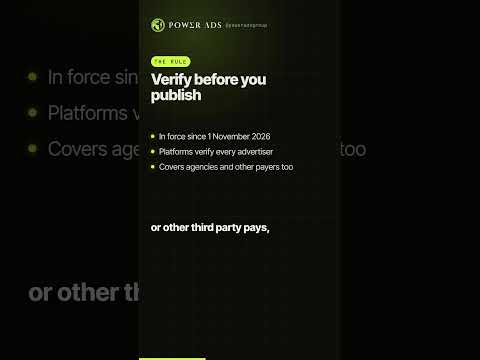 Watch the 60-second versionThailand's 'No ID, No Ads' rule: what Meta advertisers must do now · YouTube Short
Key takeaways
- Agency ad accounts change who Meta bills: charges, currency and any Thai VAT follow the provider's account, while Meta's policies, spending limits, verification and Thai law follow your ads.
- Meta adds Thai VAT when the Sold To address is in Thailand and no VAT ID is saved; with a VAT ID, the business self-assesses under the reverse charge. Thailand has no Meta location fee as of November 2026.
- Ads reaching Thailand face Meta's risk-based verification and, since 1 November 2026, the national 'No ID, No Ads' rule; financial services ads need verified advertiser and payer details.
- Food benefit claims, drugs and medical devices need Thai FDA advertising approval, prescription-only medicines can't be advertised to the public, and cosmetics need no licence but must make truthful claims.
- Meta allows no alcohol or online gambling ads in Thailand, Thai law restricts both, and crypto ads need Meta's written permission backed by an SEC Digital Asset Business licence.
FAQ
Does Meta charge VAT on Facebook ads in Thailand?
Yes, when the ad account's Sold To address is in Thailand and no Thai VAT ID is saved in Payment settings, Meta adds VAT at the applicable local rate, whether you buy for business or personal purposes. If you add your VAT ID, Meta adds no VAT and you self-assess it under the reverse charge. On an agency ad account, this follows the provider's billing details rather than yours. Meta doesn't give tax advice, so confirm the treatment with your accountant.
Is there a Meta location fee for ads in Thailand?
Not as of November 2026. Meta's location fees apply to ads delivered in Austria and Türkiye at 5%, France, Italy and Spain at 3% and the UK at 2%. Thailand isn't listed, but Meta says the list may change, and campaigns that also reach those countries pay their fees.
What is Thailand's 'No ID, No Ads' rule?
It is an Electronic Transactions Commission notification, published on 5 May 2026 and in force since 1 November 2026, requiring social media platforms to verify every advertiser's identity before ads are published. Platforms keep advertiser details for at least 90 days after the advertising relationship ends, the rules also cover third-party payers such as agencies, and a verification lasts up to a year.
Can I advertise dietary supplements to Thai users on Facebook?
Yes, but supplements are regulated as food, so an ad that presents quality, properties or benefits needs Thai FDA approval, with the approval number shown in the ad. The 2026 food advertising criteria also bar false or misleading supplement claims and supplement models under 15 or pregnant. Meta's own policies apply on top.
Can I run casino, betting or alcohol ads in Thailand on Meta?
No. Meta lists Thailand among its unsupported markets for online gambling and gaming ads, doesn't allow social casino ads there, and lists Thailand among countries where alcohol ads can't run. Thai law also penalises helping to advertise unauthorised gambling and restricts alcohol advertising under the Alcoholic Beverage Control Act as amended in 2025.
Sources
- facebook.com/business/help/1717412048538897
- facebook.com/business/help/983527276402621
- facebook.com/business/help/133076073434794
- facebook.com/business/help/562800201396939
- facebook.com/business/help/291404291014138
- facebook.com/business/help/563129151097553
- facebook.com/business/help/1238737454289085
- facebook.com/business/help/719892839342050
- developers.facebook.com/docs/marketing-api/currencies
- developers.facebook.com/docs/marketing-api/reference/ad-account/timezone-ids
- developers.facebook.com/blog/post/2025/10/27/advertiser-verification-transparency-thailand
- transparency.meta.com/policies/ad-standards/restricted-goods-services/alcohol
- transparency.meta.com/policies/ad-standards/restricted-goods-services/gambling-games
- transparency.meta.com/policies/ad-standards/restricted-goods-services/cryptocurrency-products-and-services
- transparency.meta.com/policies/ad-standards/restricted-goods-services/financial-services
- eservice.rd.go.th/rd-ves-web/assets/pdf/eService-FAQs_oct_19_2021.pdf
- tilleke.com/insights/thailand-mandates-advertiser-identity-verification-for-social-media-platforms
- en.fda.moph.go.th/our-services-new/category/cat-food-faqs
- nationthailand.com/health-wellness/40069175
- en.fda.moph.go.th/news/thai-fda-reminds-no-advertising-license-required-for-cosmetics-but-truthful-and-lawful-claims-are
- en.fda.moph.go.th/entrepreneurs-medical-devices/manufacture-import-commercialpurposes
- tilleke.com/wp-content/uploads/2024/08/Tilleke-ICLG-Pharmaceutical-Advertising-2024-Thailand.pdf
- tilleke.com/insights/thailands-updated-alcohol-law-balances-public-health-and-tourism
- multi.dopa.go.th/legal/assets/modules/news/uploads/0432fc2d73b28c02d3ef83280fbac42a5be9472084aa8061454443235972757.pdf
- sec.or.th/EN/Pages/News_Detail.aspx?SECID=12426
- sec.or.th/EN/Pages/News_Detail.aspx?SECID=11682
- tilleke.com/insights/advertising-and-gambling-thailand
- nationthailand.com/news/general/40056899
- tilleke.com/insights/thailand-issues-guidelines-on-pdpa-consent-and-notification-requirements